


Only 23% of employees feel engaged at work. That’s often framed as an engagement challenge, but it may also reflect how work is structured, supported, and experienced day to day.
Most employees want to do meaningful work. They want to contribute, grow, solve problems, and feel connected to what they do, but constant change, shifting priorities, and growing workloads can create friction that makes even highly engaged employees feel stuck or disconnected over time.
Employee motivation isn’t simply something people either have or don’t. It’s shaped by how employees experience work day to day, including communication, workload, leadership, workplace systems, and how easy or difficult it feels to make progress. Organizations that understand this are often better positioned to create the clarity, focus, and consistency employees need to perform at their best.
Motivation is more than mindset
Employee motivation is what helps people stay engaged, focused, and willing to put energy into their work, even during stressful or uncertain periods. It can be shaped by personality, as well as whether employees feel supported, trusted, and set up to succeed in their roles.
When employee motivation is strong:
- Employees take initiative
- Collaboration improves
- Performance becomes more sustainable
- Teams adapt more effectively to change
When motivation starts to decline, even strong employees may disengage or lose confidence in their ability to succeed.
The new drivers of employee motivation
Employee expectations around work continue to evolve. Different generations may prioritize different things, but across the workforce, employees increasingly want clearer priorities, flexibility, transparency, and work that feels manageable amid constant change.
Employees are asking bigger questions:
- Do I understand what’s expected of me?
- Does my work feel meaningful?
- Am I supported when work becomes difficult?
- Can I realistically sustain this pace over time?
Motivation becomes harder to sustain when the answers to those questions feel unclear.
At the same time, organizations are navigating significant pressure themselves: adapting to rapid change, managing leaner teams, implementing new technologies, and supporting employees through uncertainty. Maintaining motivation today often comes down to helping employees stay focused, aligned, and effective while navigating growing complexity and constant change.
Understanding intrinsic vs. extrinsic motivators
Motivation is typically shaped by a combination of intrinsic and extrinsic factors. Intrinsic motivation comes from within. It’s what makes work feel meaningful, engaging, or satisfying. Examples include:
- Having autonomy over how work gets done
- Solving meaningful challenges
- Building confidence and capability
- Feeling psychologically safe
- Doing work that aligns with personal values
Extrinsic motivation comes from external rewards or recognition. Examples include:
- Salary increases
- Bonuses and promotions
- Recognition and praise
- Benefits like health insurance, retirement plans, and mental health support
Many organizations have historically focused more heavily on external motivators like compensation and recognition. But sustainable motivation also depends on whether employees feel trusted, equipped to succeed, and able to work effectively without constant friction or confusion.
The strongest workplace cultures support both intrinsic and extrinsic motivators, helping employees stay engaged while also reinforcing long-term performance and well-being. When organizations support motivation effectively, the impact extends far beyond engagement scores. Employees are more likely to:
- Take initiative and solve problems proactively
- Stay connected to their work and teams
- Adapt more effectively during change
- Stay more focused and productive over time
- Stay with the organization longer
Over time, motivated teams build stronger collaboration, resilience, and performance momentum across organizations.
How to improve employee motivation
Motivation is easier to sustain when employees have clarity, the right tools, and work environments that help them stay focused and effective.
#1 Recognize contributions consistently
Recognition is one of the clearest signals that work matters. Employees are more likely to stay engaged when acknowledgment is specific, timely, and connected to meaningful contributions, not just outcomes. Small moments of recognition can have a big impact.
#2 Build confidence and capability
Confidence plays a major role in employee motivation and performance. When employees feel equipped to handle challenges and changing expectations, they’re more likely to stay engaged in their work. This is especially important for managers, who are often expected to lead teams through conflict, change, and uncertainty with limited formal training. Practical skill-building can help managers make decisions more effectively, communicate more clearly, and keep teams aligned during periods of pressure.
#3 Strengthen collaboration
Employees are more likely to stay engaged when they feel connected to their teams and understand how their work contributes to broader goals. Strong collaboration, clearer communication, and opportunities to learn from others can help reduce isolation and improve alignment across teams.
#4 Encourage autonomy
Autonomy signals trust. Employees tend to stay more engaged when they have clarity on goals but flexibility in how they achieve them. Clear direction paired with flexibility often leads to stronger ownership, creativity, and accountability.
#5 Equip employees with the right resources
According to a recent survey, 73% of employees say benefits matter as much as salary, or more. High-quality mental health support can help reduce personal strain that often affects focus, energy, and day-to-day performance at work.
#6 Reduce friction in everyday work
Everyday workplace friction can wear down motivation over time. Reducing unnecessary friction through clearer priorities, stronger decision-making structures, and more streamlined communication can help employees stay focused and productive.
Creating conditions for stronger performance
Employee motivation is less about keeping people constantly inspired and more about helping them work effectively amid change and pressure. Clearer communication, better alignment, and fewer everyday obstacles can help employees stay connected to the work that matters most.
At Lyra, we believe that transforming mental health care requires more than just the right tools—it requires courageous leadership. We’re honored to present the Workforce Mental Health Awards at our annual Breakthrough conference, to recognize the exceptional people and organizations who are setting a new standard for employee well-being.
Congratulations to our 2026 winners! Learn more about our awards program and join us as we continue to shape what great support looks like in 2026 and beyond.

Company of the Year: Cummins Inc.
Awarded to the company that has demonstrated an unwavering commitment to mental health care, achieving meaningful results across its entire workforce. This company thinks about mental health care not just as an employee benefit, but as a company-wide priority.
Through creating and sustaining their It’s OK global well-being strategy for nearly six years, Cummins Inc. is making mental health a foundational pillar of corporate culture. By reaching nearly 70,000 employees through a sophisticated multi-channel engagement model, they’ve empowered over 200 employees to share their personal stories, making meaningful progress in destigmatizing mental health at every level of the organization. Their commitment is further solidified with specialized leadership training, and the 2026 launch of the global Mental Health Ally Program, ensuring every employee—from the corporate office to the manufacturing floor—has access to a supportive, informed, and clinically backed ecosystem of care.

Leader of the Year: Joanna Kaup, Benefits Manager, T-Mobile
Awarded to a leader who has consistently prioritized the mental health care of their employees by visibly and meaningfully integrating a mental health care focus into their broader company strategy.
As the strategic architect of T-Mobile’s “LiveMagenta” program, Joanna Kaup led the transformation of a traditional EAP into an integrated mental health ecosystem that now serves as a foundational part of the employee experience. By reducing barriers to care and partnering closely with leadership, she helped shift the organization toward a more modern, accessible, and continuously evolving approach. Grounded in humility and cross-functional partnership, Joanna has driven a grassroots, engagement-focused approach to well-being, ensuring support is not just available, but meaningfully embedded across the organization.

Rising Star Award: AdventHealth
Awarded to a company in their first year with Lyra who is showing exceptional promise and commitment to bringing mental health care to their employee base.
In its foundational year with Lyra, AdventHealth successfully introduced mental health support to a workforce of 100,000 with a human-centered launch strategy that far exceeded industry engagement benchmarks. By developing custom video content and a specialized Leader Guide grounded in real-world health care scenarios, the organization made mental health care a visible, peer-supported priority. With a network of Health Champions trained as Mental Health Peer Advocates and strong leader engagement, this deliberate approach has built lasting momentum for meaningful cultural change.
Campaign of the Year: Eli Lilly and Company
Awarded to a company recognized for its creativity and effectiveness in driving mental health awareness through a campaign that truly engages and inspires employees.
Eli Lilly and Company’s Campaign of the Year elevated mental health from a traditional benefit to a performance strategy through sustained, peer-led activation. Rather than focusing on a one‑time launch, the campaign embedded Lyra within a broader mental health ecosystem—powered by executive support, mental health advocates, employee resource groups, and integrated health services—making support visible, accessible, and relevant across roles, shifts, and locations. What distinguished this campaign was how it came to life: prioritizing grassroots engagement over top‑down communications, normalizing mental health, and meeting employees where they are. Real‑time utilization insights continuously shaped the strategy into targeted workshops, manager tools, and family‑focused outreach.

Innovator of the Year: Tara Kousha, Chief People and Wellbeing Officer, Catalight
Awarded to a leader who has demonstrated a willingness to push limits and think boldly about the future of workforce mental health.
Tara Kousha joined Catalight with a vision to adapt high-impact tech benefits into a powerful mental health and well-being ecosystem for the nonprofit sector. As an early adopter of Lyra’s Organizational Health Evaluation for deep root-cause analysis, she moved beyond surface-level observations to uncover the systemic drivers of workforce burnout and distress. This data-driven approach led Tara to pioneer the first pilot of Lyra’s Manager Coaching program. By sharing her insights with the broader community at Breakthrough and in last year’s masterclass, she is ensuring her impact reaches far beyond the walls of Catalight.

Innovative Company of the Year Award: AT&T
Awarded to the HR team that has demonstrated a willingness to push limits and think boldly about the future of workforce mental health.
During a period of significant organizational change, AT&T took a bold, forward-looking approach to embed mental well-being benefits into the everyday employee experience, making mental health a core pillar of workforce support—not simply a “nice-to-have”. Led by the Benefits team, the company took meaningful steps to reduce barriers to access and meet employees where they are. This included creating a simpler front door to care, supported by a $5 million investment to bring roughly 20 licensed therapists onsite at office and call center locations across the country.

Founding Customer Award: eBay
Lyra is proud to honor eBay with the Founding Customer Award. The first organization to champion our mission 10 years ago, they continue to further the cause today. Since launching in 2016, eBay has been a fearless early adopter of essential services like medication management and seamless health plan integration. Now supporting employees across 28 countries, eBay’s impact is measurable: members have completed more than 125,000 care sessions, with 88% improving or recovering by graduation and 96% reporting their care needs were met. This award celebrates a decade of leadership, innovation, and eBay’s unwavering commitment to the mental health of their global workforce.
Managers are carrying more than ever, and it’s impacting how work gets done. In Lyra’s State of Workforce Mental Health Report, more than half say their role has negatively affected their mental health, and nearly half have considered stepping away because of the pressure.
Managers sit at the center of it all. They’re expected to deliver results, support their teams, and keep up with constant change. Over time, that weight adds up. And when they’re stretched too thin, the strain compromises engagement, decision-making, agility, and innovation.
A new standard for supporting managers at work
That’s why we’re introducing Lyra’s Manager Coaching program, a specialized 1:1 coaching solution designed for what managing actually looks like today. Whether someone is stepping into their first leadership role or leading through growing complexity, this program helps them:
- Regulate emotions to drive better decision-making
- Manage their cognitive load more effectively
- Notice and respond to signs of team strain and diminished performance early
- Navigate competing job priorities with clarity and focus
This goes beyond traditional development. It’s built for the real moments managers face, when pressure is high and decisions matter.
Managers are the lever for performance
Managers are one of the biggest drivers of employee experience and performance. Employee performance can affect mental health and vice versa. In fact, research shows that managers influence an employee’s mental health as much as a spouse, and more than a doctor or therapist.
Day to day, managers influence teams, culture, job scope, how work gets done, what gets escalated, how change is communicated and embraced, and more. So when managers are equipped to lead effectively, teams are more focused, resilient, and higher-performing. When they’re not, even the best strategies can fall short.
Why coaching (not just training) makes the difference
Most manager training focuses on foundational skills. That’s important, but it’s not enough for the reality managers are navigating today. What’s often missing is support in the moment: the ability to quickly assess what’s driving uncertainty or a drop in performance, decide what to do next, and address it effectively.
Lyra’s Manager Coaching focuses on:
- Getting to the root of workplace challenges, not just reacting to signals
- Enhancing team dynamics and alleviating workload pressures
- Evaluating work design and shaping it to empower team members
- Applying practical strategies to managers’ real-world situations
Because better decisions, made earlier, lead to better outcomes.
Designed for the realities of work
Lyra’s Manager Coaching is grounded in the latest research across management, organizational psychology, and occupational health. We prioritize quality by carefully vetting coaches, providing intensive training, and building evidence-based content. Just as important, we measure effectiveness by focusing on outcomes like engagement, skill development, and progress toward each manager’s goals, so support translates into results you can see and feel across your teams.
Optimize your workforce performance
Most organizations are already investing in performance. The opportunity is to invest where it has the most day-to-day impact.
Manager coaching is one of the most direct ways to improve how work happens, while helping retain your critical talent. When managers feel supported, teams are better able to focus, adapt, and deliver, making performance something you can sustain over time.
FAQs
What is Lyra’s Manager Coaching?
Lyra’s Manager Coaching program is a 1:1 coaching solution that helps managers navigate real situations as they happen, from tough conversations to team challenges, so they can lead more effectively day to day.
How is Lyra’s Manager Coaching different from traditional coaching programs?
Many coaching programs are either highly structured or completely open-ended. Lyra offers a consistent, evidence-based approach that helps managers assess what’s driving a situation and decide how to respond in the moment.
What kinds of challenges can Lyra’s Manager Coaching help with?
Managers can get support with challenges like burnout, difficult feedback, unclear priorities, team dynamics, and workload pressures, especially when there isn’t an obvious path forward.
How does Lyra support managers when issues go beyond performance?
Lyra’s Manager Coaching is connected to a broader mental health ecosystem, so there’s a clear path to additional care when needed. Managers aren’t left to navigate more complex or sensitive situations on their own.
Why does Lyra focus on both work performance and mental health?
The two are closely connected. Workplace challenges often have underlying causes, and addressing both helps managers respond more effectively in the moment, while sustaining their own well-being over time.
At Lyra, we’re proud to partner with benefits leaders who think boldly and prioritize the mental health of their employees. We had the privilege of speaking with Andrea Miller, Senior Mental Health Consultant at Higginbotham Insurance & Financial Services, about the company’s partnership with Lyra and how mental health support is a key part of workforce well-being.
Why is mental health so important?
Mental health is important because our brain is the epicenter to our whole body. I believe in whole-body, positive, healthy functioning, and I think it starts with mental wellness. We can’t really pay full attention to our physical wellness and our diet, nutrition, and exercise if we’re not in a really good mental health space.
What are you especially proud of?
I am so thankful that Higginbotham sees the value in having a mental health benefit. Research shows that when leadership cares about mental health, it has a trickle-down effect on each and every employee. And Higginbotham partnering with Lyra has been proof of just that. We’ve heard so many things about Lyra being such a wonderful resource. It’s simple and easy to use, and has been beneficial to our employees. I’m so proud to say that I had a hand in that.
What do you or your members love most about the Lyra benefit?
I hear so often that when a person needs a mental health resource, it’s so difficult to find. You know they’re feeling upset in that moment and it makes it even more stressful for that individual when they can’t find help.
Well, we don’t have that problem at Higginbotham because we’ve partnered with Lyra. It’s simple, easy, and our employees love it. I hear them saying things like, “Lyra was easy to navigate and really motivated me to start my journey toward working on my mental health.” And “I absolutely love it. It was easy to sign up and find a therapist. The scheduling, the videos, the whole setup is so easy. I’ve really gained a lot from my sessions.” These are actual quotes from some of our employees.
If another benefits leader asks you how or why they should make the case for a mental health benefit, what would you tell them?
I would tell them that an employee who feels good is going to be a great employee. It’s really important to have a mental health benefit. It arms HR, leadership, and the employee with tools that they need in any sort of situation, and helps them on their journey to feeling good and functioning at their best.
We talk about anxiety and depression all the time. But we often misunderstand both. Anxiety gets reduced to “stress.” Depression gets reduced to “sadness.” In reality, both are more complex—and more connected—than we tend to acknowledge.
To unpack what’s often missed, we spoke with Marlene Gomez, MA, LMFT, about how anxiety and depression actually show up in people’s day-to-day lives, and why recognizing the difference matters.
The biggest signal: impact
One of the biggest misconceptions about anxiety and depression is that they’re defined by how someone feels.
But clinically, that’s not the full picture.
“People often think they understand anxiety or depression because they’ve felt worry or sadness before,” Gomez explains. “But emotions are temporary. Clinical anxiety or depression is more persistent and begins to affect how someone functions in their day-to-day life.”
Anxiety: a mental health condition marked by persistent, excessive worry or fear that feels difficult to control and interferes with daily life
Depression: a mental health condition characterized by ongoing sadness or loss of interest and pleasure, along with changes in energy, sleep, or thinking that affect everyday functioning
Anxiety doesn’t always look like anxiety
We tend to picture anxiety as visible worry or panic. But in practice, it often shows up in more subtle—and socially reinforced—ways:
Hallmark symptoms:
- Excessive, hard-to-control worry
- Restlessness or feeling on edge
- Muscle tension and sleep problems
Less common symptoms:
- Irritability
- Stomach issues or headaches
- Perfectionism and panic attacks
“Anxiety might show up as pressure, perfectionism, or constant worry about getting things right,” Gomez says. “When things don’t go as planned, that pressure can turn inward and become harsh self-criticism, which starts to look a lot like depression.”
Depression isn’t always visible, either
Depression is often associated with sadness, but many people experience it differently.
Hallmark symptoms:
- Persistent low mood
- Loss of interest or pleasure
- Low energy or fatigue
Less common symptoms:
- Irritability or anger
- Physical aches and pains
- Slowed thinking or emotional numbness
For some, it’s not an overwhelming emotion. It’s the absence of one. And because of that, it can be easy to overlook or misinterpret.
What’s the difference between anxiety and depression?
Anxiety and depression are distinct, but they frequently overlap. In fact, research shows that nearly half of people with major depression also have an anxiety disorder.
Someone might spend the day:
- Worrying about what could go wrong
- Replaying conversations
- Anticipating failure
…while also feeling:
- Exhausted
- Unmotivated
- Disconnected from things they used to enjoy
This combination can be confusing—and easy to dismiss as “just stress.”
But there’s a clearer way to think about it:
- Anxiety is often future-focused (what might happen)
- Depression is often present-focused (what feels flat or out of reach now)
And when both are present, they can reinforce each other.
“Functional impairment is really the signal,” Gomez notes. “When anxiety or depression starts to change how someone behaves or how they’re able to engage in daily life, that’s when we begin to think about it clinically.”
What we still get wrong (and why it matters)
Even as awareness grows, many common beliefs still hold people back from getting support. Cultural messaging, social media, and even well-meaning advice can blur the reality of what these conditions actually are. Let’s clear up some of the most common misconceptions about anxiety vs depression.
- Anxiety is “just stress.”
Stress is a normal response to a challenge. Anxiety is persistent, excessive, and often disproportionate to the situation. It doesn’t switch off when the stressor passes.
- Depression is “just sadness.”
Sadness tends to pass. Depression is more persistent and involves sustained changes in mood, energy, thinking, and physical patterns such as sleep and appetite that meaningfully affect daily life.
- “If I’m functioning, I’m fine.”
Many people are considered “high-functioning”—they continue to perform at work or in daily life while struggling internally. But outward productivity doesn’t always reflect inner well-being. “There’s often a belief that strong people should just push through,” Gomez says. “But pushing through can come at the cost of your well-being. It takes courage to acknowledge that you’re struggling and ask for support.”
- “I should be able to handle this on my own.”
This belief delays support, often until symptoms worsen or become harder to manage.
- “Treatment means one path”
Effective care is personalized and evidence-based, and may include therapy, skills-building, lifestyle changes, medication, or a combination.
The goal is earlier recognition
Understanding anxiety and depression isn’t just about labeling symptoms correctly. It’s about recognizing when something has shifted:
- When worry doesn’t turn off
- When energy doesn’t come back
- When daily life starts to feel harder than it used to
That’s often the moment where support can make the biggest difference.
You don’t have to figure it out alone
Support can take different forms, but the most important step is recognizing when it might help. “We’re not meant to figure everything out alone,” Gomez says. “Getting another perspective from a therapist, coach, or psychiatrist can help people see patterns they might not recognize on their own.”
Early usage of our new AI free-text option in Lyra’s care search shows a strong signal of shifting behaviors and a better path forward to accessing the right care
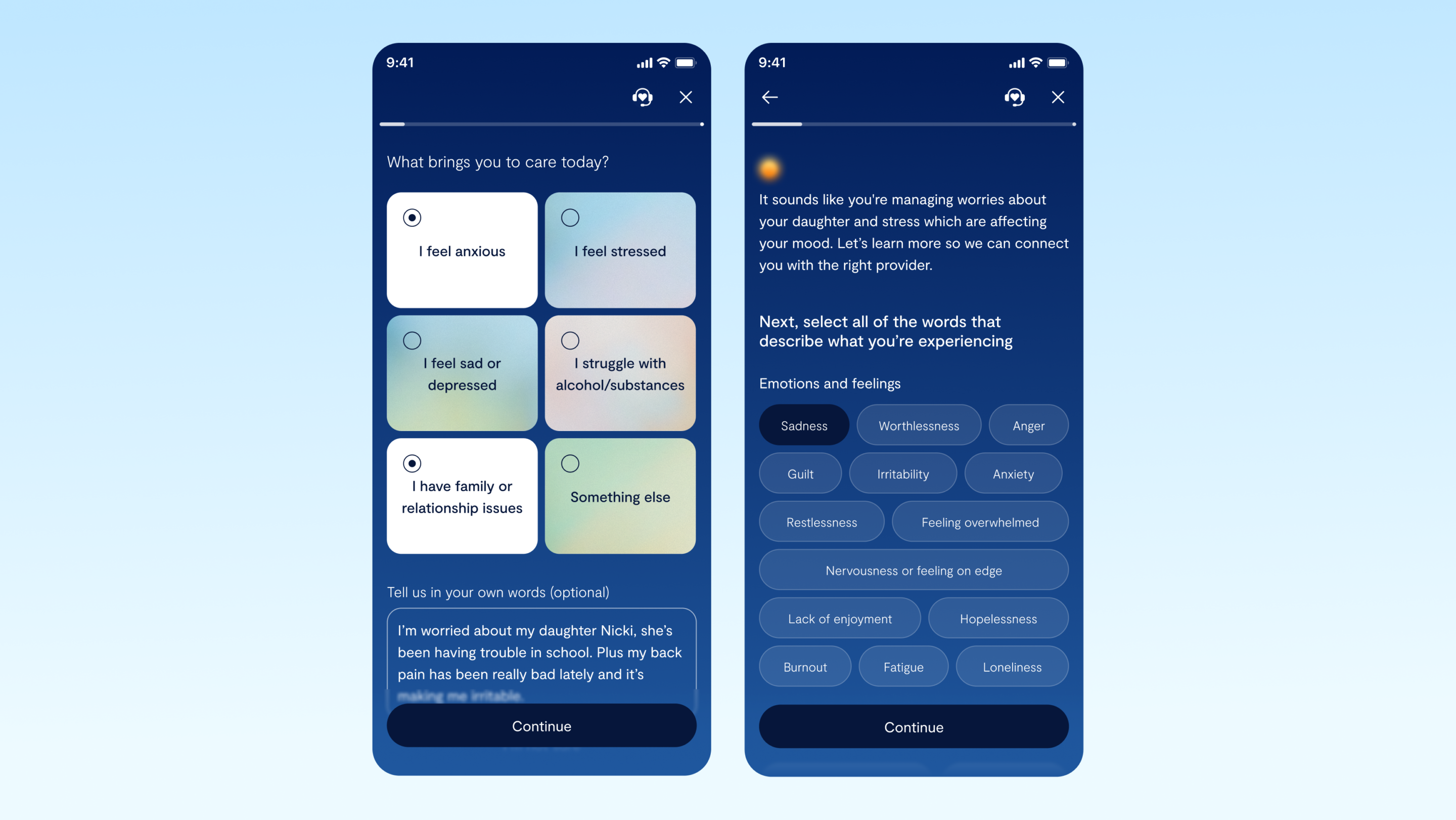
Nothing blocks the path to healing or finding what you need for your health faster than a gauntlet of drop-down menus and checkboxes. The industry standard of rigid form fills and intakes has persisted for too long.
We set out to change this 10 years ago when we designed a more human intake for Lyra members to find mental health care and a provider that fits their needs. As we continue to iterate on the most effective ways to apply AI across the Lyra platform, we asked ourselves a simple question about our care search: What if we just let people speak for themselves?
The shift: Effort to expression, with natural language-driven intake
We recently rolled out a new feature in our care search and triage process. Instead of navigating preset options, members can use a free-text interface. Powered by Lyra AI, this tool still surfaces some guiding cues but allows our members to describe what they’re feeling or thinking in their own words, which we use to get them to the right care recommendation.
Early signals: What the data says
We are in the early stages of this, with a phased rollout beginning in January of 2025. The initial engagement has been eye-opening, and we are approaching these insights with humility, knowing that early doesn’t mean absolute, but the trend is clear: people want to be able to find what they’re looking for in an unencumbered, natural way.
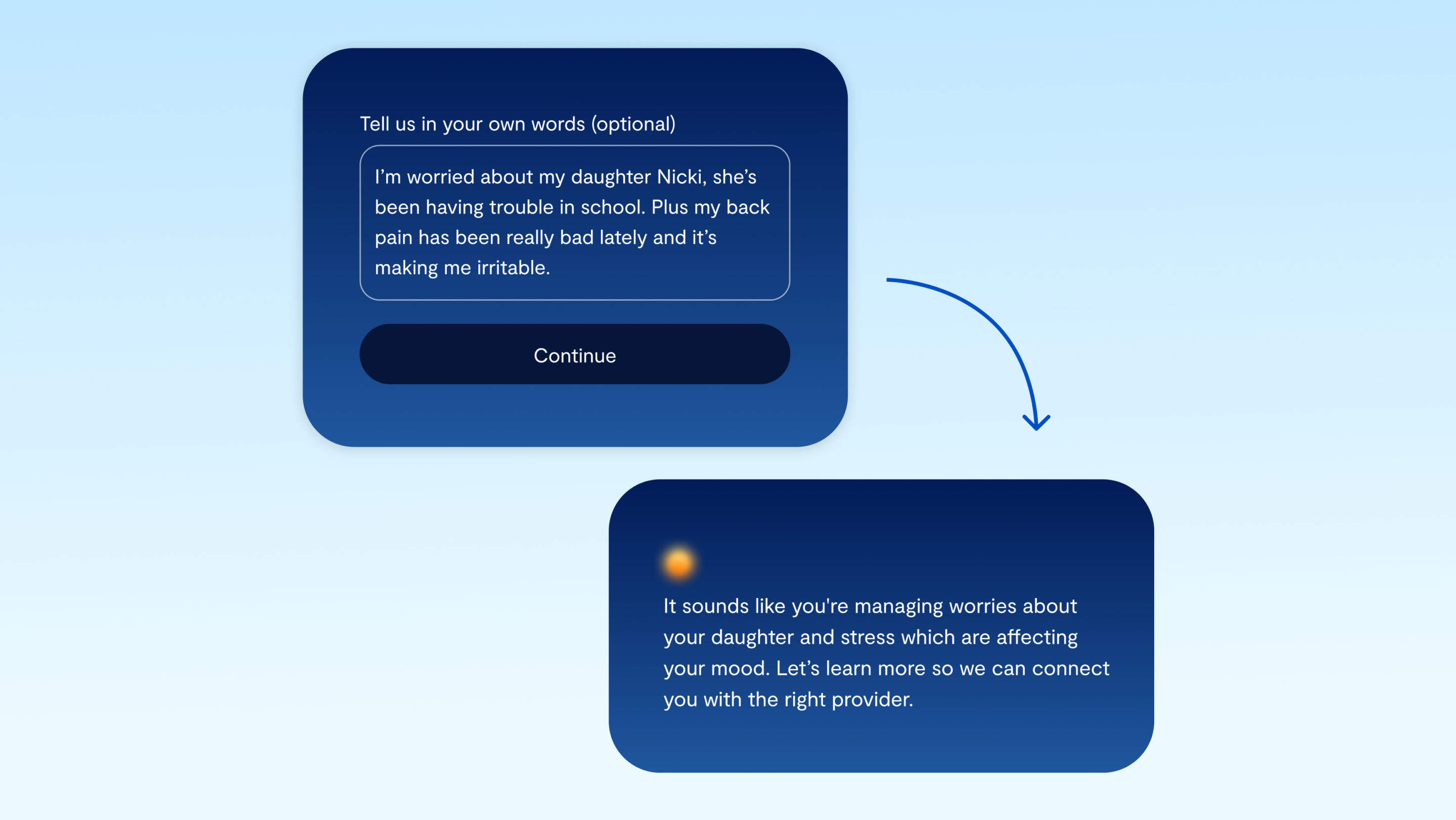
37% of members who are offered the free-text option use it. In other words, more than 1 in 3 people are choosing to bypass a more traditional experience in favor of natural language.
This is happening with an early version of free text and as part of an initial rollout where we’ve included it only as a secondary option to our standard search for care intake.
What comes next for care search
These numbers suggest that the friction of traditional health care isn’t just a nuisance, it’s a barrier that people will drop when presented with a simpler, more human alternative.
We know we haven’t solved the intake problem entirely. Rather, we’re using these early learnings to inform our continued iteration. We’re actively working to understand how our members think about their mental health before they’ve had a chance to get care, so that we can meet them with a product that speaks their language, not the other way around.
Most workplaces weren’t designed for everyone, but that’s starting to change.
For many people on the autism spectrum, work can mean constantly translating—reading social cues, navigating communication styles, or adapting to environments that weren’t built for different ways of thinking.
These moments are easy to overlook, but over time, they shape something bigger: whether someone feels comfortable speaking up, sharing ideas, or fully participating.
And the gap is real: nearly half of neurodivergent employees worry about how they’ll be perceived if they speak up, even though most say the right support would help them do their best work.
At the same time, people with autism bring strengths that teams increasingly rely on, such as deep focus, attention to detail, and new ways of solving problems.
When environments make space for different ways of thinking and working, those strengths are easier to see and easier to show.
The goal isn’t awareness, it’s not having to ask
One of the less visible challenges many people with neurodiverse conditions face at work is having to explain what they need just to do their job well or silently try to fit themselves into a “neurotypical” mold to avoid the risk of being seen as different. As understanding of autism grows, more organizations are rethinking that dynamic.
Instead of waiting for individuals to ask for support, there’s an opportunity for organizations to build it in from the start, creating environments where different communication styles, ways of processing information, and ways of contributing are expected, not exceptions.
When that happens, people don’t have to advocate for every adjustment. They can focus on their work. It reduces the pressure to mask and makes everyday interactions feel more natural, so people can show up more authentically.
Small shifts can change how people experience work
Change doesn’t always come from large initiatives. Often, it shows up in small, practical ways:
- Giving people time to process before responding
- Offering multiple ways to contribute
- Being clear about expectations instead of assuming understanding
Individually, these shifts are simple. Together, they create environments where more people can engage, contribute, and do their best work.
Support should show up in systems, not just moments
As awareness grows, organizations are thinking more intentionally about how support shows up day to day, both inside and outside of work.
Lyra’s Center of Excellence for Neurodiversity is designed to meet that need, connecting individuals with specialized assessments and care, while helping organizations build more practical, consistent support for employees with neurodiverse conditions.
From awareness to real change
Autism Acceptance (formerly Awareness) Month is a reminder that understanding is only the starting point. What matters is how that understanding shows up—in how we work, how we collaborate, and how we design environments for different ways of thinking.
Inclusion doesn’t stop at the workplace. It shapes how people experience the world around them. And when more people feel understood, supported, and able to participate fully, everyone benefits.
Employees are logged in and getting work done. But beneath the surface, something is shifting. More employees are feeling disconnected from their work and colleagues, and it’s showing up in how work gets done: fewer ideas, weaker collaboration, and a growing sense that work is getting done without real connection behind it.
And when connection fades, performance often follows. Engagement has dropped to historic lows—not because employees are doing less, but because they’re less connected to what they’re doing.
Disconnection comes from how work is structured
There are many reasons employees may feel disconnected, but how work is structured can be a major driver.
- Too much input, not enough focus – Workdays are filled with meetings, messages, and updates, leaving little room for meaningful progress
- Constant change, limited clarity – Priorities shift quickly, often without clear tradeoffs
- Managers under strain – Managers are expected to deliver results and support teams without the structure and resources to do both well
- Work that feels fragmented – Work becomes a series of tasks, not a valued contribution
Over time, this leads to feeling detached from work, teams, and outcomes. That distance tends to show up in consistent ways:
- Social disconnection – not feeling seen or supported
- Operational disconnection – unclear priorities and decisions
- Purpose disconnection – work feels disconnected from impact
Because this shift is gradual, it often goes unaddressed until performance stalls or people begin to leave.
Managers are the most strained connection point
Managers sit closest to where work happens, and where it starts to break down. They translate strategy into action and shape how employees experience work every day. But the role has changed.
Managers are now expected to carry both operational and emotional responsibility: deliver results while supporting employees through stress, uncertainty, and change. At the same time, their scope of work has expanded dramatically, from an average of 1 manager for every 5 employees to 1 for every 15.
The pressure is showing. Nearly half of benefits leaders say managers are struggling to meet goals without adequate support, while facing the emotional toll of supporting team members in distress.
Most managers haven’t been trained for this. Few are given the capacity to do it well—even as organizations invest more in manager resources, the need continues to outpace support.
When the layer responsible for connection is under strain—management—connection doesn’t hold.
Why more communication isn’t fixing the problem
When disconnection shows up, many organizations respond by increasing communication—more updates, more meetings, more messages. But more communication doesn’t create clarity. It creates noise.
Employees are already operating in a constant stream of information. Adding more often just fragments attention further.
Connection isn’t built through volume. It’s built through how work actually functions:
- How priorities are set
- How decisions are made
- How managers show up in everyday moments
This often isn’t a communication problem. It’s an operating system problem.
How to rebuild connection at work
When people are feeling disconnected at work, the solution isn’t typically adding more programs—it’s improving how work is designed.
#1 Make clarity the foundation
When priorities and ownership are clear, people can focus their energy where it matters.
- Align on the top three priorities regularly
- Clarify tradeoffs when new work is added
- Define ownership and decision rights
#2 Strengthen managers as the connection layer
Managers aren’t a middle layer. They’re infrastructure.
- Protect time for meaningful 1:1s
- Reduce unnecessary reporting and administrative burden
- Provide training and targeted support
- Show managers where to direct employees for mental health support
#3 Reduce digital overload
Digital overload is one of the most common drivers of feeling detached and disengaged. Connection requires space.
- Audit meeting volume and after-hours expectations
- Clarify decision ownership
- Normalize asynchronous work
#4 Build psychological safety
Psychological safety helps prevent employees from feeling disconnected. People contribute more when they feel safe to do so.
- Normalize disagreement
- Respond constructively to mistakes
- Reward transparency
#5 Embed belonging into everyday work
Belonging is a critical counterweight to feeling disconnected at work. It’s built through everyday team interactions and consistency.
- Make recognition specific
- Ensure equitable visibility and access to growth
- Build inclusive habits into team routines (e.g., rotating who speaks first, sharing agendas in advance)
#6 Treat mental health as part of performance
Mental health isn’t separate from performance, it enables it.
- Make support visible, accessible, and easy to navigate
- Equip managers with information to guide employees to care
- Normalize conversations about workload and capacity
When mental health is supported proactively, it’s easier to prevent employees feeling disconnected before it escalates.
The path back to connection
Connection strengthens when people have what they need to do their best work—clear priorities, consistent support, and real opportunities to contribute. When those are in place, employees move beyond simply logging in. They become more invested, collaborative, and engaged in what they’re building—and who they’re building it with.
FAQs
#1 What does it mean to feel disconnected at work?
Feeling disconnected at work can show up in different ways. Some employees feel detached from their work, unsure how their efforts contribute to larger goals. Others feel disconnected from their team or manager, with less support or collaboration than they need. The work still gets done, but with less energy, purpose, and engagement behind it.
#2 Why are employees feeling disconnected right now?
There’s no single cause. Most employees are navigating a mix of constant change, unclear priorities, heavy workloads, and digital overload. When work becomes reactive and fragmented, it’s harder to stay focused, aligned, and connected to what matters. Over time, that can lead to feeling disconnected, even in high-performing teams.
#3 What are the signs an employee is feeling disconnected?
Employees who are feeling disconnected don’t always disengage visibly. Instead, the signs are often subtle:
- Contributing fewer ideas
- Participating at a surface level
- Pulling back from collaboration
- Showing less initiative or ownership
These shifts tend to build gradually, which is why they’re often missed until performance or retention is affected.
#4 How does feeling disconnected affect performance?
When employees are feeling detached from their work, performance doesn’t necessarily drop right away. It shifts over time. Teams may see less creativity, slower problem-solving, and weaker collaboration. Over time, this can impact productivity, engagement, and retention.
#5 How can leaders address employees feeling disconnected?
Focus on how work operates day to day:
- Clarify priorities and decision ownership
- Support managers so they can support their teams
- Reduce digital overload (e.g., unnecessary meetings)
- Create space for meaningful contribution (e.g., focus time, structured ways to share ideas)
- Build psychological safety so employees feel comfortable speaking up and contributing
- Make mental health support visible, accessible, and easy to navigate
Small, consistent changes often have the biggest impact.
#6 Is feeling disconnected the same as burnout?
Not exactly. Burnout is tied to chronic stress and exhaustion, while feeling disconnected is a loss of connection to work, people, or purpose. The two are related, though. Over time, feeling disconnected at work can contribute to burnout, especially when support and clarity are lacking.
At Lyra, we’re proud to partner with benefits leaders who think boldly and prioritize the mental health of their employees. Northwestern Mutual is the winner of Lyra’s 2025 Workforce Mental Health Rising Star Award. Since launching with Lyra in 2024, the company has shown exceptional promise and commitment to bringing mental health care to its employee base.
We had the privilege of speaking with Stephanie Hosig, Northwestern Mutual’s Benefits Consultant, about the company’s partnership with Lyra and how mental health support is an essential component of business success.
What is your philosophy around caring for a workforce?
Northwestern Mutual’s focus is to free Americans from financial anxiety. Our People and Total Rewards teams aim to bring that same care to our employees and their families. We ask: how do we provide the care and resources people need to show up as their best selves? What will help them feel more secure? Partners like Lyra are a key part of that.
What are you especially proud of?
That’s a simple one. I’m most proud of the way we’ve opened up the dialogue about mental health and helped others feel less alone. Lyra’s platform has been really instrumental in facilitating these important conversations.
What do you or your members love most about the Lyra benefit?
Lyra has been a fantastic partner for Northwestern Mutual. We needed a partner who would help drive our mission forward, and Lyra has been with us every step of the way.
Personally, one of the things that I love most about Lyra’s benefit is the flexibility to find the care you need across different platforms. If you’re having a tough day at work and just need a moment to recenter yourself, you can open the Lyra app and do that. Or, if you like to work with a therapist in person, you have the flexibility to do that too. The flexibility for employees to find the type of care that works for them has been invaluable.
If another benefits leader asks you how or why they should make the case for a mental health benefit, what would you tell them?
Offering mental health care is essential for a comprehensive benefits package, especially if you aim to attract and retain top talent. In today’s competitive job market, employees expect their employers to support their overall well-being, and mental health is a crucial part of that. By providing quality mental health benefits, you demonstrate a genuine commitment to your employees’ health and to fostering a supportive and productive work environment.
If you’re unsure how to approach neurodiversity in the workplace, you’re not alone. According to Lyra Health’s 2025 Workforce Mental Health Trends Forecast, most benefits leaders recognize the importance of supporting neurodiversity at work but don’t know where to start. By making small changes, you can create an environment where everyone is set up for success.
What is neurodiversity?
Neurodiversity describes how brains naturally work in unique ways. “Neurotypical” refers to people whose thinking patterns are more common. “Neurodivergent” describes brains that work differently, sometimes linked to conditions like attention-deficit/hyperactivity disorder (ADHD), dyslexia, and autism spectrum disorder (ASD). The term “neurodiversity” celebrates and appreciates the many different ways people think, learn, and experience the world.
What is neurodiversity in the workplace?
People with neurodivergent traits often shine in areas like problem-solving, spotting patterns, thinking outside the box, and uncovering innovative solutions. They might also deal with things like sensory sensitivities, emotional overwhelm, reading social cues, or challenges with tasks like planning and staying organized. Without the right support, employees with neurodivergent conditions can be less effective and face extra stress, anxiety, or depression due to misunderstandings, workplace bias, or rigid workplace structures.
Supporting neurodiversity in the workplace
As more people speak up about their needs, it’s clear that companies can’t afford to overlook neurodiversity at work. Supporting it isn’t just the right thing to do—it’s key to attracting and keeping talent and fostering a culture of innovation and long-term success.
Neurodivergence looks different for everyone, so there’s no one-size-fits-all approach, but here are some general, yet effective strategies to support neurodiversity in the workplace:
#1 Provide structure and consistency
Take the guesswork out of the workplace by setting clear expectations around performance, communication, and daily routines. Keep workflows and structure consistent, provide step-by-step instructions, and use project management tools to help everyone stay on track.
#2 Make work “work” for everyone
A few small adjustments can greatly improve comfort and productivity. Consider flexible work like remote or hybrid options, and offer accommodations such as quiet areas, noise-canceling headphones, adjustable lighting, movement breaks, and alternative seating to support efficient neurodiversity in the workplace.
#3 Customize communication
Talking openly about learning and communication preferences helps build stronger teams. Providing instructions in multiple formats—whether written, verbal, or recorded—ensures clarity for everyone. Be patient when communicating. Ask employees if they understand your directions and goals, and be open to explaining ideas and instructions in different ways. Likewise, offering meeting options, such as sharing agendas in advance, allowing written input, or giving employees the option to keep cameras off during virtual calls, fosters a more supportive and efficient environment. And just as patience is key when managing neurodiverse employees, managers should also give themselves grace as they learn and adapt to different communication styles.
#4 Build confidence with coaching and mentoring
Mentorship, coaching, and employee resource groups (ERGs) give employees a place to ask questions, build confidence, and grow their careers. Whether it’s navigating workplace challenges or learning how to advocate for themselves, these resources help employees make the most of their strengths.
#5 Make “inclusion” more than a buzzword
Create a more successful workplace by fostering a welcoming culture that includes training on neurodiversity in the workplace and bias awareness. It’s also important to use language that celebrates different experiences and weave neurodiversity into DEI programs, leadership initiatives, and ERGs. Beyond training, inclusive practices should extend to performance reviews by focusing on each person’s unique strengths and work style.
#6 Make your mental health benefit work for everyone
Employees with neurodivergent conditions may face added stress or anxiety at work. To ensure they have access to the right support, offer benefits that include:
- A robust provider network with clinicians who understand neurodiversity
- Diagnosis and care for adults, teens, and children
- Tools to help parents advocate for school resources and navigate their child’s diagnosis
- Digital content for adults and teens to better understand neurodiversity
- Manager workshops and workforce education to foster an inclusive environment
Support neurodiversity, strengthen your workplace
Creating a truly inclusive workplace isn’t just about accommodations—it’s about building a culture where every employee feels valued, understood, and supported. That starts with listening, learning, and taking action to help all workers reach their full potential.